|
Todays Date: |
| Ancient Iranian Army |
| Pre-Achaemenid Armies | |||
During the latter period of the Assyrian empire the peoples of the Iranian plateau gain greater prominence in Assyrian vassals. Indeed the Median peoples, in alliance with the Scythians, and the Chaldeans, brought down the Assyrian empire. Dayyauku, the first leader of the Medians united them in general revolt against Assyria. Though the revolt was unsuccessful, the unification of Media had grave implications for Assyria. Khshathrita, the next king, ousted the Assyrians and took a lot of land using a hit and run tactic. His army would often descend from the mountains to strike at the Assyrians and flee back into the mountains when the Assyrian Army responded. Though their foot soldiers could not match Assyria's, Media's cavalry was far more powerful. Khshathrita was later killed during a Scythian raid, leaving Huvakhshtra to ascend the throne.Huvakhshtra ousted the Scythians, extracting revenge. Then, in alliance with Babylon, Huvakhshtra took continued his conquests, claiming most of Iran, the Caucaus mountains and eastern Antolia. | |||
Achaemenid Army | |||
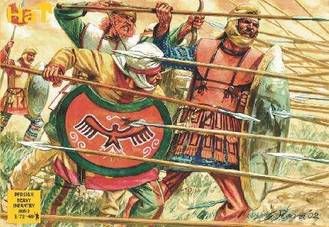
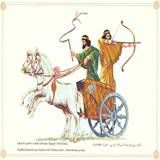
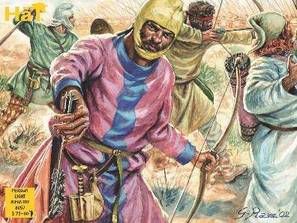
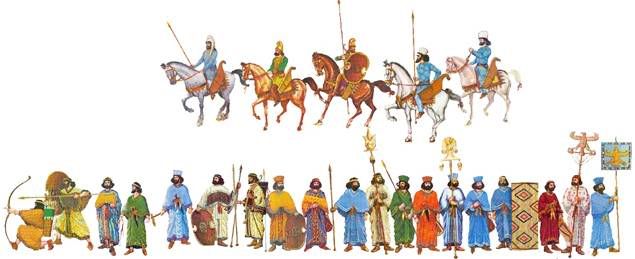
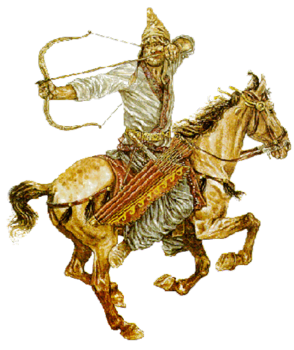
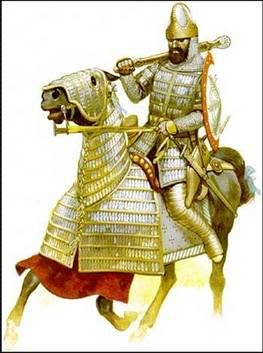
One of Kuroush's relatives and a general in his army, Darayavus (Darius) was furious upon hearing of the imposter on the throne. Resolving to reclaim the throne he took a small battalion and killed the imposter and his supporters. During his reign Darius took land in Northern Thrace, India, and Central Asia. The Persain army was divided into units by a factor of 10, similar to the Romans. Most divisions had their own standards and insignias. These soldiers wore scaled armour under tunics. Some wore bronze, others Iron. Elite warriors, and nobility wore gold-plated armour. The shields used by the army also came in many shapes, forms, and uses. The Spara shields were large shields made of reed that were used on the front lines to protect the advancing army. Smaller shields were oval in shape but had two circular cut outs on either side, making two handed spears more usable. Among the many types of swords the Kopis was the favorite. It had a curved blade which gave it more leverage and a longer cutting edge than the Greek double-sided swords, perfect for decapitating. Its heavy blade allowed it to be used against heavier infantry. Most soldiers also also carried an Akinankes as well. This dagger originated in northeast Iran and was versatile and useful. Spears were important to the army as well. Usually about 9 or 10 feet long, they were used two handed or one handed. Some were also shorter and javelin shaped for throwing. Counterweights were placed on the ends of spears to make them balanced in weight distribution. These counterweights were circular in shape so as to prevent any accidentaly injuries from the thrusting motion to the soldiers behind. Persian forces used small composite bows which were versatile but not the most powerful. Greek soldiers would pull the arrows back with their thumb and index fingers, while Persian soldiers would use their index and middle fingers, giving them more strength and distance. Their archery was often used for blanketing enemy formations at distances. This made it effective against lightly armoured combatants but only effective against heavily armoured enemies at short distances. The army was divided in cavalry and infantry. Chariots were rare, obsolete, and mainly restricted for command positions as oppopsed to actual battle. A group of about 10,000 elite soldiers who were called, according to Herodotus, the immortals were also created. Their name as immortals was seems to be false. There is no mention of such names in Persian texts and some scholars theink that Herodotus confused the word of company, Anooshiya with the word for immortal Anausha. Herodotus was most likely referring to the royal guard, who were the best fighters from the Persian camp. Among other advancements, high-ranking officials were given authentic documentation to prove their position. Most soldiers had the right to take their wives along on campaigns. Soldiers from other nations were also hired or conscripted for their abilities. Phoenician seafares were masters of shipbuilding and were readily employed in naval conflicts. Greek and Nubian mercenaries were also utilized for their skills. The military of Iran greatly advanced under Achaemenid rule.
| |||
Parthian Army | |||
| |||
Sassanid Army | |||
Post-Islamic Resistance For, political reasons many have claimed that Iranians blatantly accepted Islam.
These assertions are based off political motives and historically speaking are hideously incorrect. During the subsequent invasion by the Islamic Arabs, Iran was
devastated. The Arabs pillaged towns, murdered people and raped women. In the wake most ancient Iranian libraries were burnt to the ground, on grounds that their
teachings did not match Islam. The royal carpet at the Persian capital of Cteisphone was torn to pieces and burnt to show Islam's hate for material things. Near where
Cteisphone was burnt down, the Arabs built their capital Baghdad, with the help of a Persian! | Omar, one of Muhammad's most loyal followers, throughout his devastating genocides took many Iranians as slaves. One Iranian by the name of Peeroz came to him begging for relief from the overburdening taxes which were put upon non-muslims, especially as he was only a slvae. Omar asked him what he did as a job, he replied that he was worked as a slave engineer, carpenter, and weaver. Omar exclaimed that someone of his skill should be able to live with what litlle money he gets, especially since he was a non-muslim. The next day at morning prayers Peeroz ran up on Omar and pulled out a sharp shank, stabbing him six times over and killing him. Meanwhile in Iran many were equally fed up. Abu Muslim, also a slave (hence the name), led a rebellion until he was eventually killed. In the wak of his rebellion were inspired others. Militants in Iranians northern provinces stepped up their attacks, making the provinces of Gilan and Mazanderan off limits to the Arab armies. Meanwhile in the Khorassan the so-called "black shirts" rebelled against Arab rule. As in western Iran, a self-educated famer, by the name of Abdullah, converted back to Zoroastrianism, changed his name to Babak, and lead a deadly guerilla campaign. It was here the art of guerilla warfare was perfected. As many as 500,000 Arab soldiers and conscripts died by the hit and run tactics of his "red shirts". Eventually Babak was caught (thanks to a traitor among his own men) and horrifically slaughtered by his Arab captors. Though Babak died, in Gilan the resistance continued. Eventually Yaqoob-e-Leis appeared on the scene and moved to free Iran. Afraid of losing his empire the Caliphate offered to give Yaqoob Iran back, here is the letter Yaqoob wrote, sign, Indeed yaqoob may well have taken Baghdad back were it not for traitors among his soldiers. And so at the close we see that in the history of Iran the heart and soul of the warrior have always had an important place. |